
Peace on Earth?
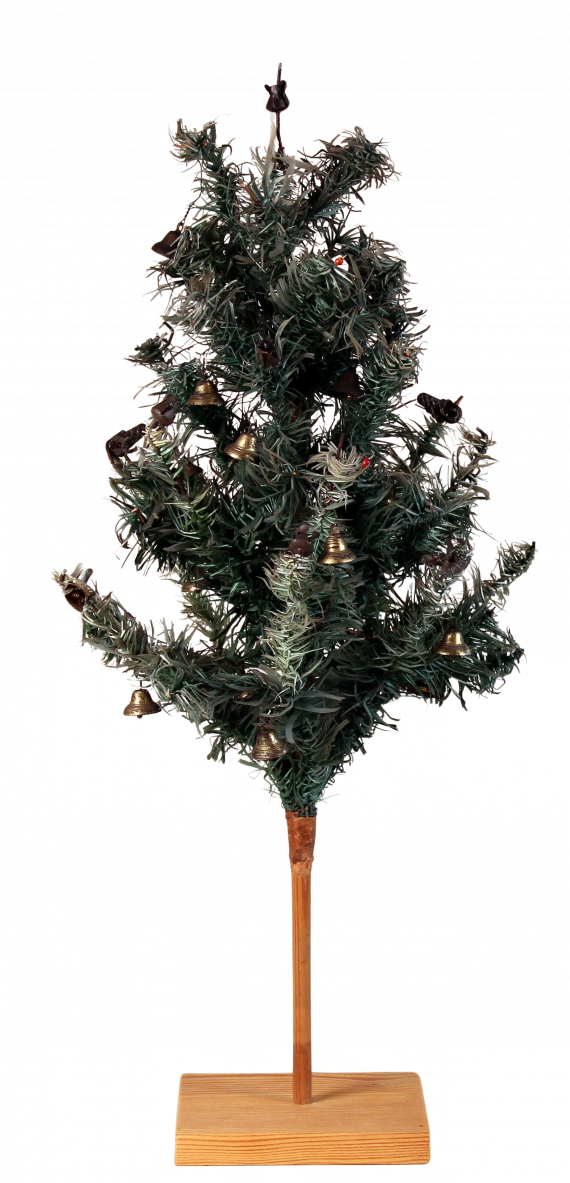
The world was anything but peaceful when Christmas was celebrated under this tree. Since the summer of 1914, Europe had been engaged in a war largely caused by Germany, which was to quickly expand into the First World War. From the two regiments of the garrison town of Erlangen alone, about 3000 were killed by 1918, in addition to over 1000 university members and citizens.
The initial confidence in German victory soon disappeared. Neither had the promise of being 'back home by Christmas' come to pass. Rather, the population as well as the troops needed to be got in the mood for their first wartime Christmas. With an enormous propaganda effort, army command requested the population send their relatives at the front gift packages – so-called 'gifts of love'. Together with tens of thousands of decorated little Christmas trees, these were supposed to counteract any weakening in the will to fight and win.
Wartime Christmas tree
Wood, waxed paper pine needles
1914/15
Like many of his comrades at the front, Hans Hahn (1889–1950) was able to enjoy a collapsible Christmas tree during the first winter of the war in 1914. The corporal from Windsbach was deployed on the Western Front until he suffered an eye injury in 1916. After the end of the war, he brought the tree home with him.
Crises end to end?
Prelude to disaster?
The First World War concealed the origins of a series of crises whose full impact was not felt until after fighting had come to an end, and which became a permanent burden on the state and democracy.
In Germany, an estimated over 800,000 people died in Germany during the war as a result of malnutrition, as less and less food of ever poorer quality was available. Bread was baked from low-quality flours without sufficient nutritional value.
As a result of unsustainable war financing, monetary devaluation began as early as 1914, which blew out to hyperinflation after the end of the war. It reached its peak in 1923, when the state became further destabilised by the Ruhr crisis and Hitler's coup. Currency reform succeeded in mid-November 1923 with the introduction of the Rentenmark. In the lead-up, issuing supposedly stable, gold-backed emergency currencies was permitted as an interim solution. The subsequent economic upturn was fragile and modest. The Great Depression of 1929 ended the trend and, at the same time paved the way to disaster.
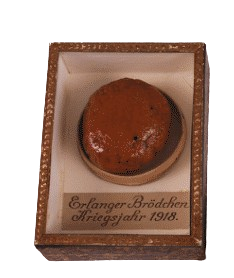
Erlangen Kriegsbrötchen
1918
To commemorate the difficult supply situation during the First World War, this undersized Brötchen (bread roll) was kept, then donated to Erlangen's folk museum some time later.
Emergency currency of the Municipality of Erlangen with printing block
November 1923
At the height of hyperinflation, state printing presses were no longer able to meet the enormous demand for banknotes. As a result, municipalities and businesses were given permission to issue their own Notgeld (emergency currency). It functioned more like a voucher and was only valid for a limited period of time.
When will we have a real summer again?
In times gone by, a rainy summer was more than just unpleasant, it was a genuine cause for concern. Grain and field crops would not ripen, stores would remain empty. This was followed by hunger, disease, death and despair. Between 1770 and 1772, excessively cold and humid weather led to what probably amounted to the worst famine in 18th century Europe. In Erlangen, bakers kept their doors locked and only sold their goods through the windows. Otherwise, the crowds would have ripped the bread straight out of the ovens.
45 years later, a volcanic eruption in Indonesia caused a worldwide famine as a giant ash cloud massively affected the climate. The year 1816 went down in the chronicles as the 'year with no summer'. In Erlangen, continuous dampness and frosts during the spring destroyed a large part of the harvest. Heavy snowfalls as early as the beginning of November worsened the situation.
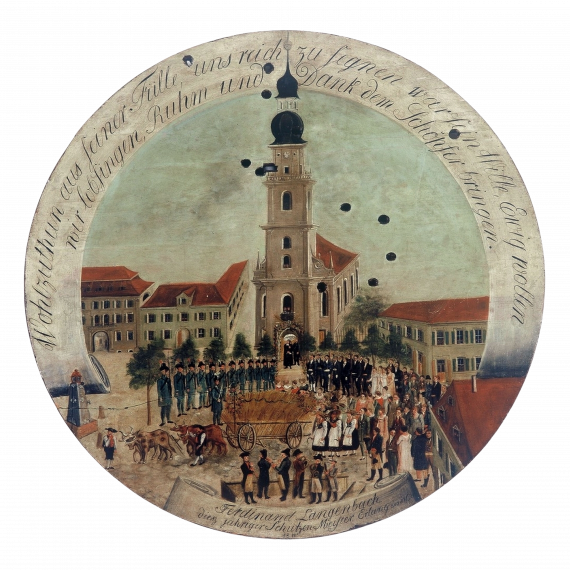
All the more deeply felt was the relief when the 1817 harvest turned out to be a particularly good one. Erlangen's population expressed their joy and gratitude with festive thanksgiving processions and celebratory church services.
Johann Simon Piehlmann
The crush of the hungry outside Puy's bakery
Oil on canvas
1771
This scene of bread being sold through the bakery windows at today's number 32 Goethestraße was captured as viewed from the house diagonally opposite (today's 17 Goethestraße). Johann Simon Piehlmann (1753–1813) was a journeyman dyer and owed his interest in painting to his father, a master dyer, who at the time was a self-taught artist of some repute in Erlangen.
Shooting target depicting a harvest thanksgiving procession
Oil on board
probably 1817
Special events were often recorded on shooting targets, in this case the festive harvest thanksgiving procession outside the Old Town Church in 1817.

Vaccinated yet?
The outbreak of the global COVID-19 pandemic in the spring of 2020 turned everything upside down in Erlangen, too. Overnight, shops and schools were closed, personal contacts restricted and infection control rules established to curb the spread of the novel coronavirus.
The hope of a swift end to the pandemic hinged on the development of a vaccine. That moment arrived as early as December 2020: several vaccines appeared on the market almost simultaneously. In order to 'get vaccines into arms' as quickly as possible, a vaccination centre for both the town and surrounding district was set up in an empty Erlangen sporting goods store. Charged with its operation was the municipal cultural office, which was well equipped for this mammoth task based on its experience in organising major events.
The last dose was administered here on 23rd December 2022 – after two years of continuous operation and almost 600,000 vaccinations. With the end of the pandemic, the vaccination centre became 'fit for the museum', and the town museum took numerous objects, including hundreds of vaccine vials, into its care.
COVID-19 vaccine from Erlangen's vaccination centre
2021
This cryobox, in which the vaccine vials were kept cool, contains vaccines by manufacturers Biontech/Pfizer and Johnson & Johnson.
A festival of light in dark times?
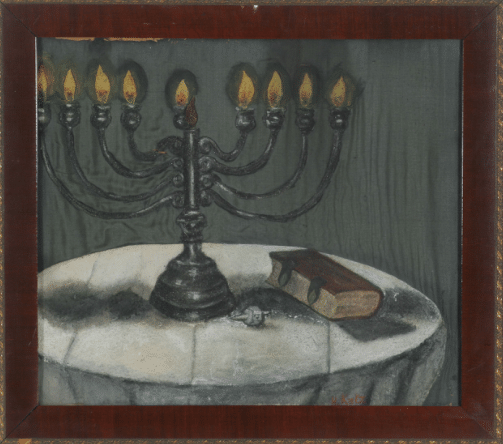
Every year, Jews celebrate Hanukkah by lighting a candle for eight consecutive days. These are commemorating the renewed dedication of the ancient temple of Jerusalem after victory over the Seleucids: Although there had only been enough oil for one day, the temple's candelabra had remained alight for eight days.
Erlangen Jew Hildegard Katz dedicated this silk painting to the Hanukkah miracle, and donated it to the Jewish community in 1925 for a raffle on occasion of the Purim festival. These were politically turbulent times: Antisemitism had been rising in Erlangen, too; a few years later, the National Socialists came to power. Erlangen's Jews were persecuted, expelled, deported and murdered – including Hildegard Katz, who died in the Auschwitz extermination camp in 1943.
Yet her painting survived these dark times: It had been won in the raffle by the Jewish Dingfelder family, who took it with them when they fled to the USA in 1938. In 1980, Adolf Dingfelder donated the painting to the Municipality of Erlangen.
Hildegard Katz
Still life with Hanukkah candelabra
Oil on silk
before 1916
Between the eight candles commemorating the Hanukkah miracle, there is a ninth, the 'servant', which is used to light them. On the table are placed a prayer book and a Dreidel (spinning top), a traditional Hanukkah toy. The painting was probably created before 1916. Less than 50 years earlier, Jews had still been prohibited from settling in Erlangen.
'Not so bad' after all?
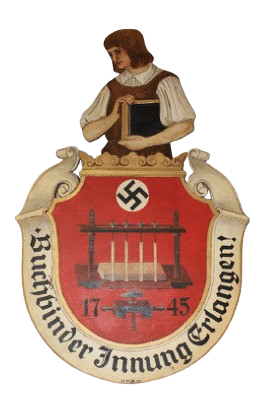
After the National Socialist takeover on 30 January 1933, some kept hoping that things surely wouldn't get that bad. But in Erlangen, people knew better by the first days of March at the latest: SA men looted and devastated the Haus at 10 Nürnberger Straße, the head office of the social democratic Erlanger Volksblatt (Erlangen People's Paper) newspaper. It's managing editor-in-chief Michael Poeschke (1901–1959) was severely mistreated, and imprisoned for over a year.
On March 9, the Nazis took possession of the building. Now referred to as Adolf-Hitler-Haus or Braunes Haus (brown house), the NSDAP district leadership and other Nazi organisations moved in. The free press had been silenced. Oppression and violence soon secured the supremacy of the regime.
Nazi propaganda and symbolism were omnipresent. The guild sign of Erlangen's bookbinders from 1933 shows how quickly and thoroughly all areas of life had been penetrated: the old German costume emphasises German virtues and traditions which, in the spirit of National Socialism and symbolised by the swastika, were to rise to an imagined new greatness.
NSDAP office sign from the Braunes Haus (brown house) at number 10 Nürnberger Straße
Enamelled sheet metal
around 1933
This sign was discovered in 1976 when the house was demolished. The Müller company chemist's shop is located there now.
Erlangen Bookbinders' Guild sign
1933
Play or propaganda?
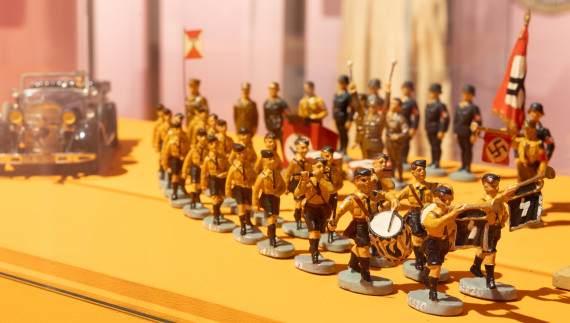
Toys represent the world in miniature, and often reflect their times – as applies in these figurines from the National Socialist dictatorship years. Shown here are marching SA members wearing the emblematic Braunhemd (brown shirt), drummers, trumpeters and flag bearers, Jungvolkpimpfe (recruits in the junior division of the Hitler Youth organisation), Wehrmacht soldiers, but also members of the leadership cadre: at the lectern stands Adolf Hitler (with articulated 'salutation arm'), next to him Hermann Göring, Joseph Goebbels, Rudolf Hess, and SA leader Ernst Röhm, who was murdered in 1934. This was a way of playfully familiarising small children early on with the insignia and rituals of the regime, and indoctrinating them with Nazi ideology.
Remarkable is the wooden grandstand showing signs of a later 'denazification' attempt: the swastika at the back has been crudely scratched out. Thus, traces of the dictatorship remained visible even in the 'small world' of toys.
Nazi period toy figurines
Elastolin; Manufacturer: O. & M. Hausser
around 1933
Where from and where to?
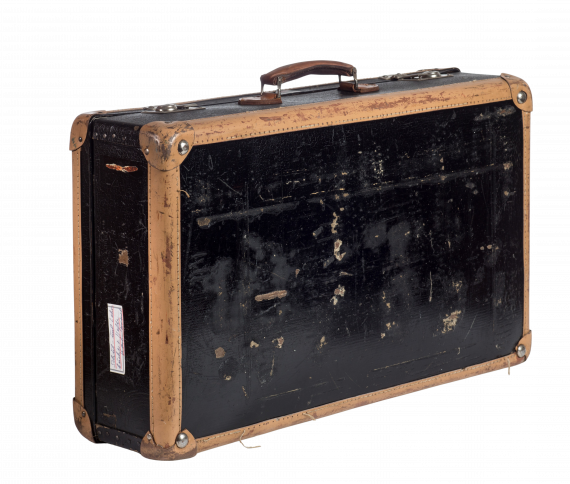
When Hermine Weinberger fled before the Red Army in January 1945 with her three children and only four suitcases from the West Prussian town of Schneidemühl, her birthplace Erlangen was already set as their refuge destination.
Her husband had managed at the last minute to get his family onto one of the completely overcrowded refugee trains heading west. He himself was unable to escape conscription into the Volkssturm (lit. 'people's storm') militia, and soon lost his life. His wife and children reached Erlangen unscathed and initially stayed at their grandmother's two-bedroom apartment on Harfenstraße.
Cramped living conditions and lack of housing were among the greatest challenges in Erlangen during the final phase of the Second World War and its aftermath. The town, which had been largely spared from bombing raids, was a key destination for countless refugees and displaced persons. Together with its establishment as a Siemens company site, this had a lasting impact on society and the townscape after the Second World War.
Refugee suitcase
before 1945
This is one of four suitcases that then 15-year-old Karl-Ernst Weinberger, his mother and his two siblings took with them when fleeing to Erlangen. On its side, it is labelled 'school, text + exercise books Karl-Ernst'.
A fine length of cloth?
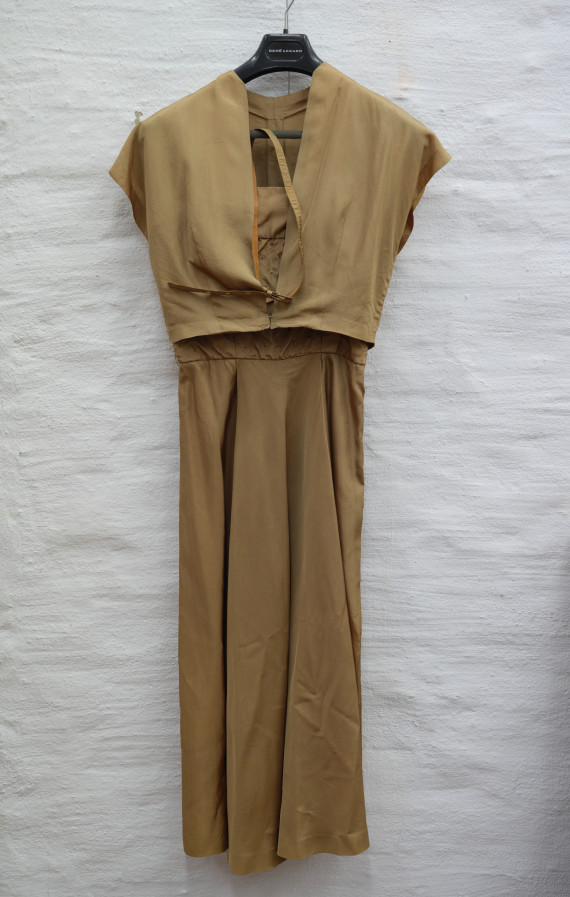
The post-war years in Germany were marked by scarcity and privation. Yet despite all day-to-day worries, the desire to dress elegantly for festive occasions remained. Fine fabrics, however, were difficult to procure. Materials that had up to recently been used for war purposes, such as flags, blankets and uniforms, were put to new, civilian use. The shimmering and flowing weave of parachute silk was particularly sought after among women. Since the 1940s, American parachutes had been made of nylon, which stood out by its wonderful shimmer.
In 1947, Elise Henriette S., who was born in Erlangen in 1924 and grew up on Südliche Stadtmauerstraße, had a dress cut from the silk of a disused American parachute, too – on the occasion of her marriage to medical student Michael P. But because of a lack of funds for a larger celebration, she only had a civil ceremony, wearing a black suit. The 'wedding dress' – to its owner a precious garment meant for an important life event – was worn as a ballgown for many years.
Wedding and ballgown
US-American parachute silk
1947
A town within town?
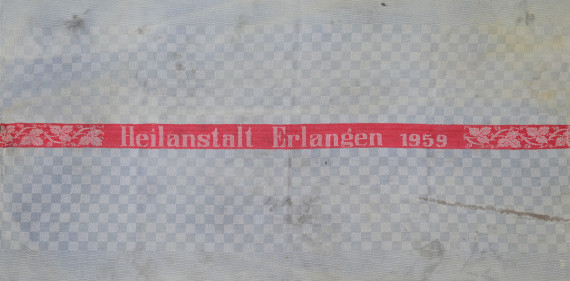
When it opened in 1846, Erlangen's Kreis-Irrenanstalt (District Lunatic Asylum), later called Heil- und Pflegeanstalt (lit. 'Cure and Care Institution') or HuPflA for short, was regarded as one of the most modern institutions for the treatment and care of people with mental illness in Germany. The extensive complex was a 'town within a town', including workshops, vegetable gardens, and a chapel.
In 1978, the new Klinikum am Europakanal (Canalside Hospital) took over from the HuPflA. Despite its architectural significance, the HuPflA was largely demolished and replaced by buildings housing the Faculty of Medicine. In 2018, fierce debate flared up about the planned demolition of the last remaining patient accommodation wing, which had also been a backdrop to serious crimes.
During the Nazi period, the institution had been involved in murdering patients: over 900 patients had been deported and murdered in the gas chambers as part of the 'T4' extermination campaign, and around 1000 more had been systematically starved to death or had succumbed to neglect in the institution. To commemorate the victims of Nazi 'euthanasia', a memorial site is planned for a remaining section of the building.
Towel from the Heil- und Pflegeanstalt
1959
Only one object from the former Heil- und Pflegeanstalt is in the Town Museum's collection: this towel from 1959.
A precursor to the Internet?

Today, news spreads on the net in seconds. A few decades ago, quite different forms of messaging were still relied upon here and there.
Into the 1960s, in smaller villages, parish beadles announced everything of general interest by Ausschellen (lit. 'ringing out') – from the annual control of the potato beetle to cultural events. Johann Schmitt had held this office in Eltersdorf for decades. He attended the various squares of the village in all weathers, rang his big handbell and read his announcements – in uniform, of course. In addition, this part-time farmer had other tasks to perform in the service of the community, being also active as meat inspector and wedding bidder.
A completely new era dawned in Eltersdorf a few years after the town crier's handbell had fallen silent. Having been just a village until a moment ago, it stood on the threshold of being part of a large town in 1972, the year of its merger with the Municipality of Erlangen.
Town crier's handbell from Eltersdorf parish
Brass
This bell entered the collection in 1972. The reason was probably the incorporation of Eltersdorf parish into the Municipality of Erlangen.
Werner Lorleberg – a hero?
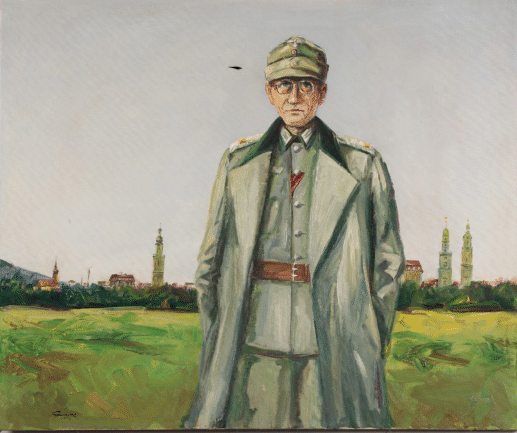
In the painting, Werner Lorleberg looks nothing like a hero as he cuts a somewhat lost-looking figure against the backdrop of Erlangen. In complete contrast, the inscription on the memorial plaque conveys the heroic image of a man acting fearlessly.
The treatment of Lorleberg as a historic figure is marked by such contradictions to this day. As Lieutenant Colonel he was Kampfkommandant (Combat Commander) for the town of Erlangen from 9th to 16th April 1945, and thus its highest-ranking military commander, whose authority extended to all civil authorities as well. In this capacity, he disobeyed the strictly binding directive of defence 'to the utmost' that was in force at the time. At the last minute, he surrendered Erlangen to the US troops, who were already standing at Burgberg (Castle Hill), without a fight. The town escaped destruction and thousands of lives were saved.
Many questions related to these events have not been completely resolved to this day. Did Lorleberg act on his own conclusions or did he merely give in to pressure from others? Did he take his own life or did he die a 'sacrificial death'? Lorleberg's story is sure to remain a divisive subject into the future.
Oskar Johannes Stanik
Werner Lorleberg (1894–1945)
Oil on canvas
1984
The artist places Lorleberg in the Erlanger Wiesengrund, not far from Thalermühle, where the Kampfkommandant (Combat Commander) died in unknown circumstances on 16th April 1945, immediately after the capitulation.
Memorial plaque for Werner Lorleberg, salvaged from the Regnitz river
Iron
2010
The Lorleberg monument has repeatedly become a target for vandalism. The original inscription carved in stone was destroyed in 2009. The subsequently installed cast iron plaque disappeared shortly afterwards and had to be replaced. The old plaque was found years later in the Regnitz river and handed to the Town Museum.
